
Skip to content
  • Skip to primary navigation
  • Skip to main content
Stern Center for Language and Learning logo

Stern Center for Language and Learning

Life-changing learning for all

  • Client Login
  • Careers
  • Contact
  • Donate
  • For Learners and Families
        • Tutoring Services
          • Reading, Writing, and Math Tutoring
          • Learning Disability Support
          • Adult Learners
          • Summer Learning
        • Social Emotional Learning
          • Speech Therapy
          • Social Thinking
          • Autism Services
          • Social Learning Summer Programs
        • Evaluations
        • Reading Readiness Check-Up
        • Student Stories
        • Financial Assistance
        • Academic Calendar
        • News & Resources
  • For Teachers
        • Courses, Coaching, & Workshops
          • Structured Literacy Coaching for Teachers
          • Orton-Gillingham Training
          • Wilson Language Training®
          • Social-Emotional Learning Courses
          • Assessment and Evaluation Courses
          • MindPlay Comprehensive Reading Course
        • Hoehl Institute for Professional Learning
          • Reducing Costs for Teachers
          • Teacher Impact Stories
          • Resources & Newsletter
  • For Schools
        • Programs and Support for Schools and Districts
          • Structured Literacy Training and Coaching
          • Orton-Gillingham for Schools
          • Wilson® Reading Programs
          • Social-Emotional Learning for Schools
          • Reducing Costs for Professional Development
          • School Impact Stories
  • About Us
        • About
          • Our Team
          • Board of Directors
          • News & Annual Reports
          • Careers
          • Contact Us
        • Ways to Give

“Eye’ve” Got it!

April 21, 2017

I read a lot; always have. Fifty novels a year. Various weekly and monthly publications. Regular professional articles and occasional books. Encountering a new word used to lead me to the dictionary, which meant getting up and walking to my reference shelf, but now I just use my iPod to google the vocabulary interloper and then hope to claim it as my own.

One such recent word is “saccade,” which I encountered in Mark Seidenberg’s “Language at the Speed of Sight.” This time Google was insufficient, because I wanted to know why we care about “a rapid movement of the eye between fixation points.”

Turns out this eye movement, particularly the tracking and fixating we exercise while reading is essential in terms of both helping identify persons with reading challenges and in what we do about it once we recognize it.

Struggling readers are slow to identify printed words, yet skilled readers can recognize a word in less than one-quarter of a second. In that time, the mind launches orthographic and phonological processes that accomplish word recognition. It stands to reason that those with less efficient (e.g. more frequent and longer fixation periods of eye movement, saccades (see I own that word now!), will be inhibited in the rest of the cognitive process essential to reading with fluency, recognizing and linking letters with sounds.

Reading fluency is now considered a combination of reading accurately, at a rate, and with intonation that combine to create meaning and comprehension. Without fluency the mere mechanics of decoding or pronouncing a series of words is nothing more than a list, not a sentence, much less a novel. Eye movement is one key factor, and efficient readers exercise eye tracking unconsciously. We can see it on newscasts when anchor people read from tele-prompters, and we occasionally witness interruptions in the process when the process doesn’t  align or compute, and the result ends up in the network’s blooper video.

Beyond learning new words from my reading, I’m struck by the number of times something I happen to read links with something else in my immediate, daily life. In this case, my new word “saccades” links to the Stern Center’s Symposium session on May 19, 2017 entitled, “The Eyes Have It: Understanding the Cognitive Processes Involved in Silent Reading.”

This session will feature Dr. Jane Ashby, co-author of “Psychology of Reading” (2016). Dr. Ashby is an Associate Professor of Psychology at Central Michigan University, where she teaches and directs a laboratory that studies how cognitive processes operate in real-time during silent reading.


[instructor id=”2436″]

Filed Under: For Teachers, Reading Support

For Learners
  • Tutoring Services
  • Evaluations
  • Social Learning & Speech Therapy
For Teachers
  • Courses & Workshops
  • Structured Literacy Coaching & Teacher
  • Orton-Gillingham Training
  • Wilson Language Training®
  • Newsletter
For Schools
  • Structured Literacy Coaching & Teachers
  • Orton-Gillingham for Schools
  • School Support
About Us
  • Mission & Values
  • News & Resources
  • Giving
  • Careers
  • Contact Us
  • Media Center
  • Privacy Policy
Connect with Us
  • Facebook
  • Instagram
  • LinkedIn
  • YouTube
  • PL Newsletter
Hearts Icon

This website is made possible thanks to
the generous support of Deborah Schapiro & Louis Polish and Margie L. & Peter Stern

Stern Center

Because all great minds don’t think alike.

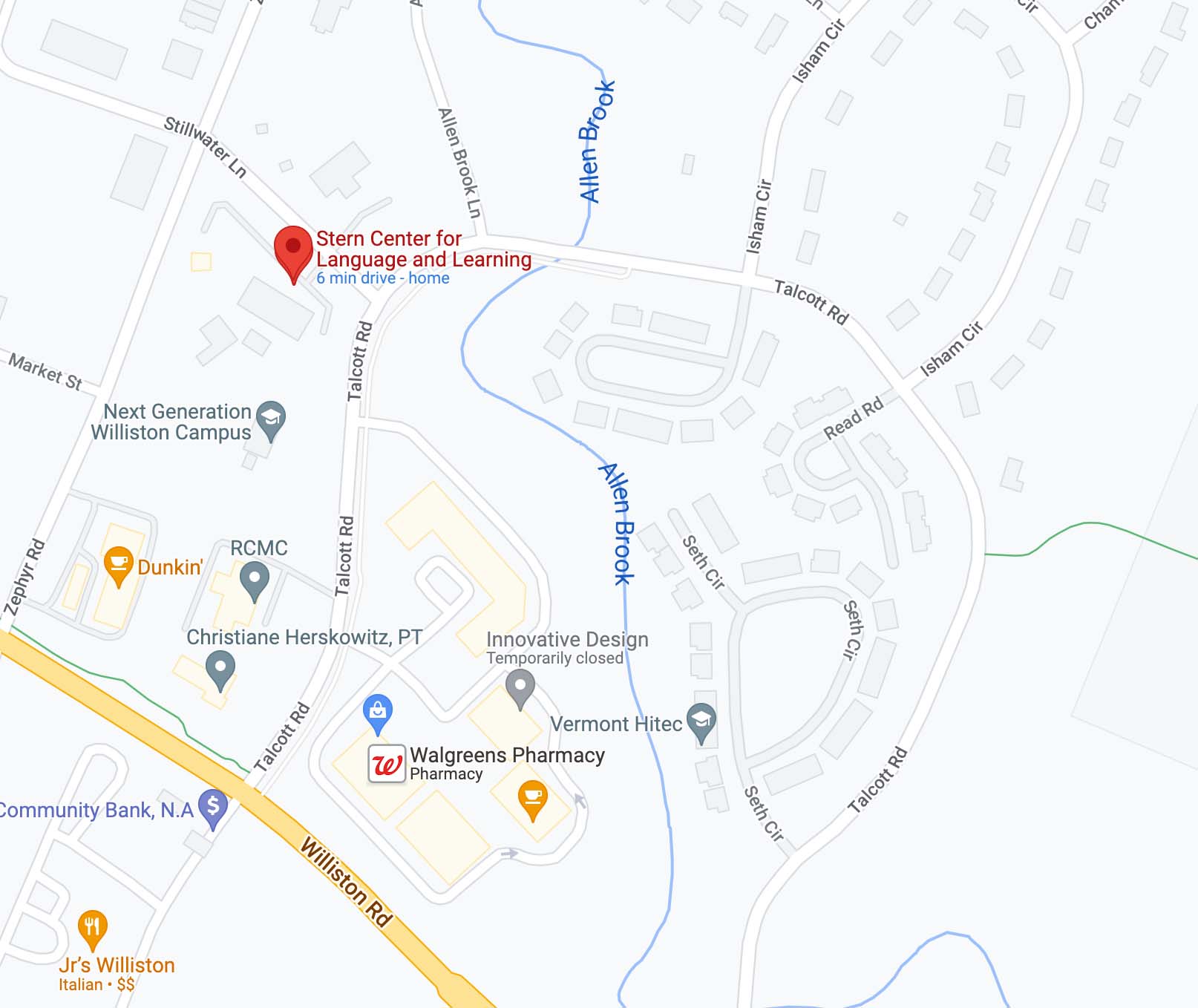
Map of Stern Stern Center for Language and Learning
Click to enlarge

Stern Center for Language and Learning

183 Talcott Rd #101
Williston, VT 05495
Phone: 802-878-2332
Fax: 802-878-0230
EIN:  222485793

  • Facebook
  • Instagram
  • LinkedIn
  • YouTube
Contact Us

Copyright © 2026 Stern Center for Language and Learning
Website by Stride Creative Group