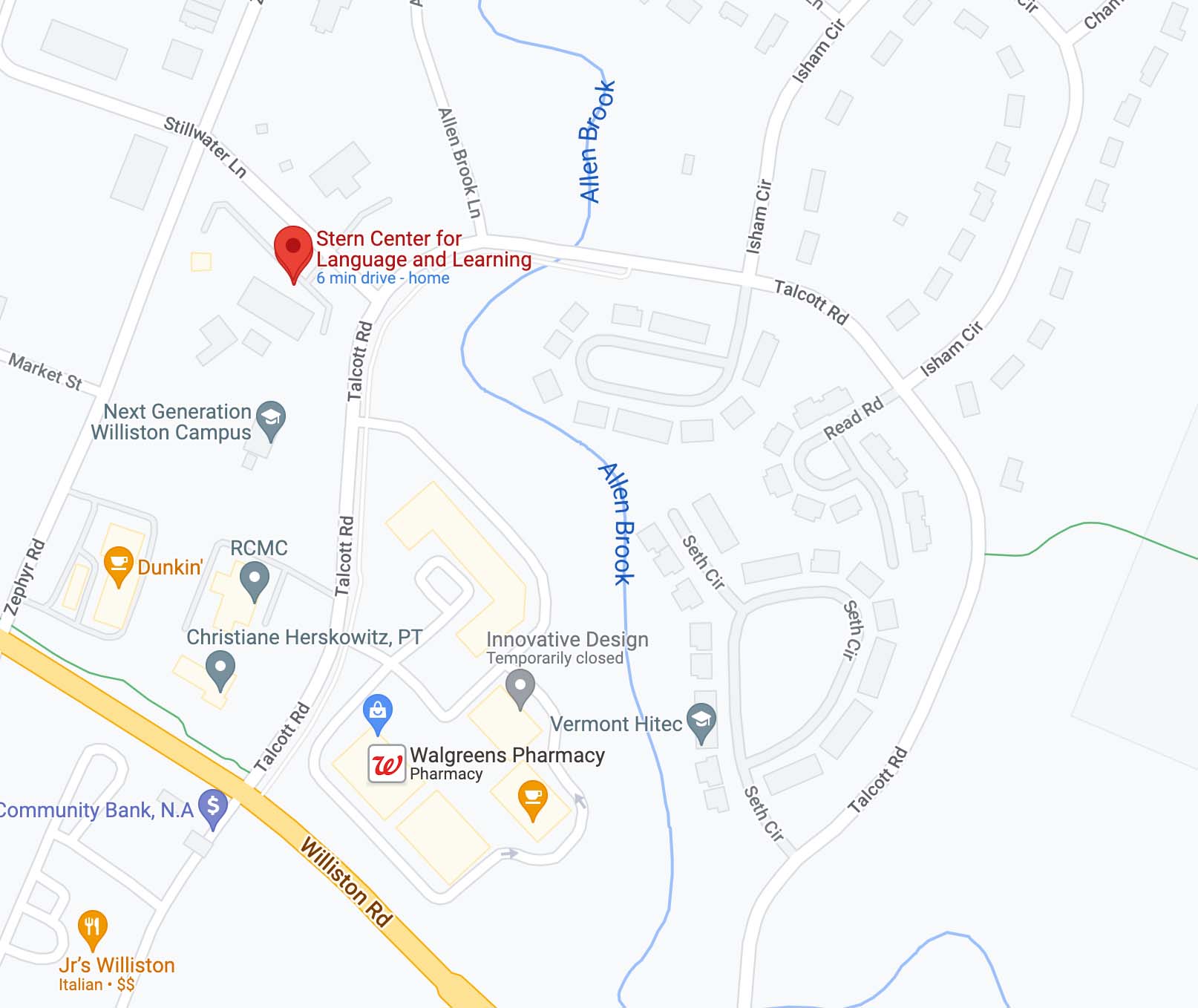
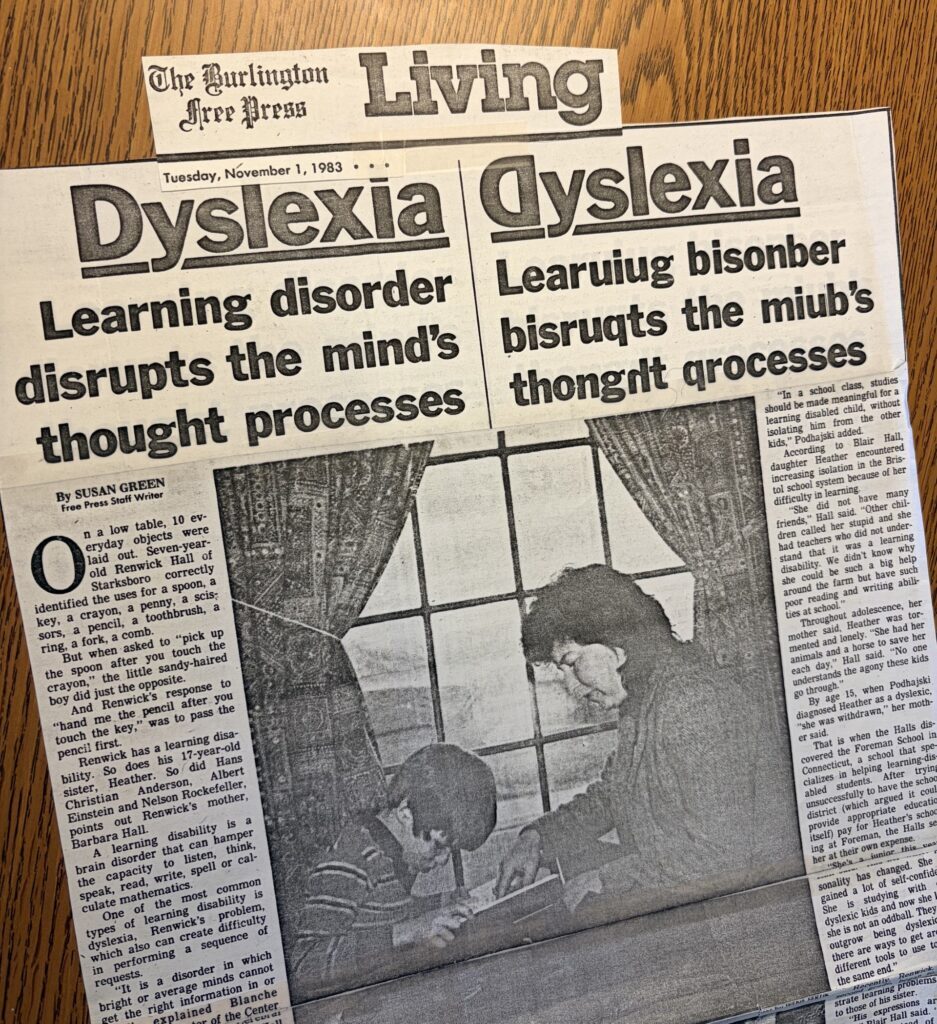
We are starting a new segment, focusing on the treasure trove of our physical archives from the past 43 years. We’ve unearthed a 1983 article from Burlington Free Press staff writer Susan Green, about the then-named Center for Language and Cerebral Function titled “Learning disorder disrupts the mind’s thought process.”
It’s interesting to look back on what informs our current work at the Stern Center. Below is an excerpt from the article – keep in mind that some of the language used is out of date, but the message is as relevant as ever.
Dyslexia: Learning disorder disrupts the mind’s thought processes
Burlington Free Press, Tuesday, November 1, 1983
By SUSAN GREEN, Free Press Staff Writer
The article prints both “Barbara Hall” and “Blair Hall” for Renwick’s mother; both are kept as printed.
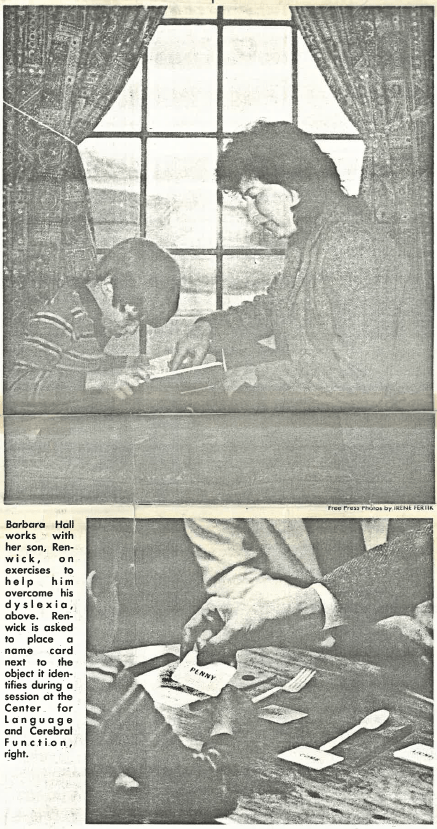
On a low table, 10 everyday objects were laid out. Seven-year-old Renwick Hall of Starksboro correctly identified the uses for a spoon, a key, a crayon, a penny, a scissors, a pencil, a toothbrush, a ring, a fork, a comb.
But when asked to “pick up the spoon after you touch the crayon,” the little sandy-haired boy did just the opposite.
And Renwick’s response to “hand me the pencil after you touch the key,” was to pass the pencil first.
Renwick has a learning disability. So does his 17-year-old sister, Heather. So did Hans Christian Andersen, Albert Einstein and Nelson Rockefeller, points out Renwick’s mother, Barbara Hall.
A learning disability is a brain disorder that can hamper the capacity to listen, think, speak, read, write, spell or calculate mathematics.
One of the most common types of learning disability is dyslexia, a language problem, which also can create difficulty in performing a sequence of requests.
“It is a disorder in which bright, or average, minds cannot get the right information in or out,” explained Blanche Podhajski, director of the Center for Language and Cerebral Function, where Renwick Hall was being tested. “The connection between concept and language is affected.”
When Renwick was asked “Why is it important for cars to have license plates?” he replied: “You’ll crash into other people’s cars.” He cannot formulate the words to convey what he knows, according to the center’s notes on that exchange.
The non-profit center is temporarily situated in the Aesculapius Medical Center. In November, Podhajski and her associates will move to a permanent home on Essex Avenue, where they will provide service, training and research. They will examine people with suspected impairments and offer instruction to the learning disabled, family members and school teachers. Teachers will be able to observe through a one-way mirror. The center also will train students and professionals in the fields of education, speech pathology and neurology.
G. Reid Lyon, coordinator of the center’s research and training programs, said he hopes learning disabled students will be able to apply the remedial approach in their own environment.
“Our diagnostic classroom will resemble as closely as possible the situation the child must return to,” he said.
“In a school class, studies should be made meaningful for a learning disabled child, without isolating him from the other kids,” Podhajski added.
According to Blair Hall, daughter Heather encountered increasing isolation in the Bristol school system because of her difficulty in learning.
“She did not have many friends,” Hall said. “Other children called her stupid and she had no idea why she couldn’t understand that it was a learning disability. We didn’t know why she could be such a big help around the farm but have such poor reading and writing abilities at school.”
Throughout adolescence, her mother said, Heather was tormented and lonely. “She had her animals and that’s it. She cried each day,” Hall said. “No one understands the agony these kids go through.”
By age 15, when Podhajski diagnosed Heather as dyslexic, “she was withdrawn,” her mother said.
That is when the Halls discovered the Foreman School in Connecticut, a boarding school that specializes in helping learning-disabled students. After trying unsuccessfully to have the school district (which argued it could provide an appropriate education itself) pay for Heather’s schooling at Foreman, the Halls sent her at their own expense.
“She’s a junior this year” Hall said. “And her whole personality has changed. She has gained a lot of self-confidence. She is around other dyslexic kids and now she knows she is not an oddball. They never outgrow being dyslexic, but there are ways to get around it, different tools to use to get to the same end.”
Recently, Renwick, now in second grade, began to demonstrate learning problems similar to those of his sister.
“His expressions are backward,” Blair Hall said. “He says window up instead of window down, for example.”
The Halls took Renwick to the center without delay. The school system, Blair Hall said, agreed to pay the costs of his testing and remedial work.
“We’re dealing with Renwick,” Hall said. “The mask has been removed from my eyes. I’ll never let what happened with Heather happen again.”
“You are told the child is just lazy,” Podhajski said. “Or that he’s hyperactive. You are made to feel guilty. Parents and children both get frustrated. When a child is diagnosed as having a learning disability, it’s a relief to know it is something physical.”
Nancy Clapp of Colchester discovered that educating a dyslexic child can be an uphill battle. Her 17-year-old son Andrew, a senior at Colchester High School, was diagnosed as having a specific learning disability during second grade.
“Everyone else in his class was reading like crazy and he was retreating,” Clapp said. “When everybody else in second grade can read ‘Run, Jane, run!’ and you cannot, you don’t have a very good self-image. He did everything [else just fine, but there was] this great big empty hole. He just couldn’t read.”
The local elementary school was “not really convinced that he needed the type of help that was recommended to us by Blanche Podhajski, who tested Andrew,” Clapp said. She arranged for Andrew to be excused from school two afternoons a week for private tutoring, using a phonetic approach to teaching the learning disabled.
“Andrew soared once he learned to read,” Clapp said. “The most dramatic change was in his self-esteem. You’re never cured of dyslexia, but you learn to compensate.” It’s the initial time spent wondering what to do, before the problem is diagnosed and the remedial treatment recommended, that is the hardest, she added.
“There are answers,” Clapp said. “There are people who can give answers. You just have to persevere.”
The goal of the Center for Language and Cerebral Function is to make it possible for Vermont schools to offer appropriate special education for dyslexics.
“It’s unnatural to remove a child from the school or the home,” Lyon said.
Nationally, an estimated 16 percent of school-age children are considered to have learning disabilities. In Vermont, 2,752 such children have been identified by the education department, according to Podhajski, who points out that this represents only about 3 percent of the student population.
“I think the lower percentage is because they have so far only counted children with the most severe learning disabilities,” she said.
Four Chittenden County school districts already are interested in the center’s program, Podhajski said. The input sought from teachers would be a two-hour observation a week for 10 weeks, as well as five total hours of conferences and training geared to working with one particular learning-disabled child. The center will have both general instructional videotapes for teacher training (children before and after intervention) and tapes geared to a specific child and his remedial program.
A two-month waiting list has been reduced to two to four weeks with the recent arrival of Lyon, who came to Vermont from Northwestern University in Illinois, where he was a professor of communicative disorders. Podhajski, for seven years director of the Center for Disorders of Communication at the Medical Center Hospital of Vermont, has been in private practice at Aesculapius for the past two years.
“At our new center, we will be able to handle eight diagnostics a week and work with four diagnostic classroom kids every three months,” she said. “This will be the most comprehensive program of its kind in the state.”
To meet first-year expenses, the center is trying to raise $75,000. The Stern Foundation of New York has donated seed money. Volunteers (the 20-member Friends of the Center) and board members hope to raise additional funds locally, as well as such things as office furniture, videotaping equipment, a photocopier, a calculator.
The center will open officially on Nov. 18, when it holds an open house, complete with music and refreshments.
Photo captions
Barbara Hall works with her son, Renwick, on exercises to help him overcome his dyslexia. Renwick is asked above to place a name card next to the object it identifies during a session at the Center for Language and Cerebral Function, right. Free Press Photos by Irene Fertik
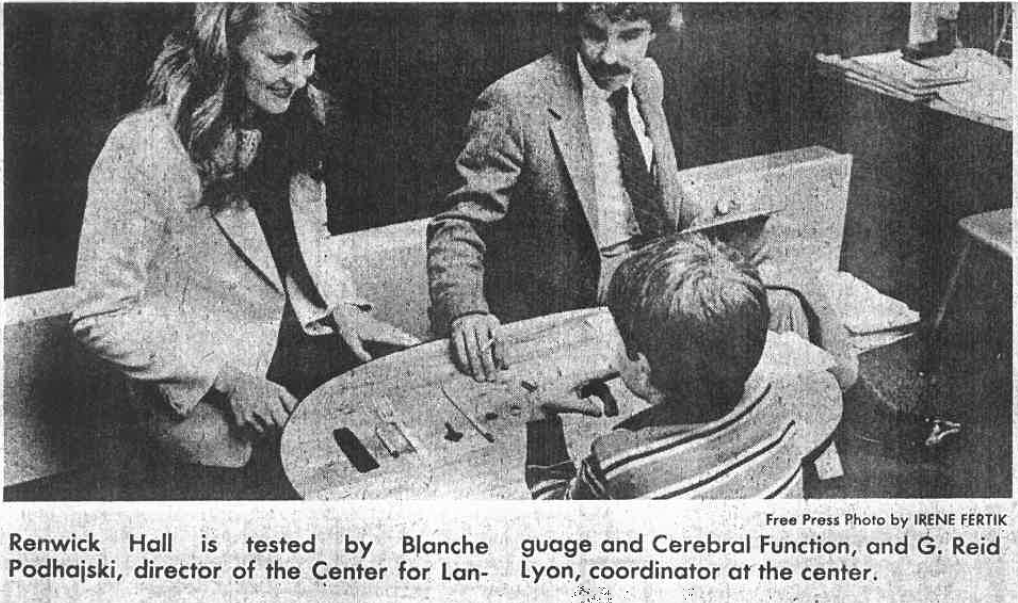
Renwick Hall is tested by Blanche Podhajski, director of the Center for Language and Cerebral Function, and G. Reid Lyon, coordinator at the center. Free Press Photo by Irene Fertik