Skip to content
  • Skip to primary navigation
  • Skip to main content
Stern Center for Language and Learning logo

Stern Center for Language and Learning

Life-changing learning for all

  • Client Login
  • Careers
  • Contact
  • Donate
  • For Learners and Families
        • Tutoring Services
          • Reading, Writing, and Math Tutoring
          • Learning Disability Support
          • Adult Learners
          • Summer Learning
        • Social Emotional Learning
          • Speech Therapy
          • Social Thinking
          • Autism Services
          • Social Learning Summer Programs
        • Evaluations
        • Reading Readiness Check-Up
        • Student Stories
        • Financial Assistance
        • Academic Calendar
        • News & Resources
  • For Teachers
        • Courses, Coaching, & Workshops
          • Structured Literacy Coaching for Teachers
          • Orton-Gillingham Training
          • Wilson Language Training®
          • Social-Emotional Learning Courses
          • Assessment and Evaluation Courses
          • MindPlay Comprehensive Reading Course
        • Hoehl Institute for Professional Learning
          • Reducing Costs for Teachers
          • Teacher Impact Stories
          • Resources & Newsletter
  • For Schools
        • Programs and Support for Schools and Districts
          • Structured Literacy Training and Coaching
          • Orton-Gillingham for Schools
          • Wilson® Reading Programs
          • Social-Emotional Learning for Schools
          • Reducing Costs for Professional Development
          • School Impact Stories
  • About Us
        • About
          • Our Team
          • Board of Directors
          • News & Annual Reports
          • Careers
          • Contact Us
        • Ways to Give

Word Games, Etymology, Jabberwocky, Diagramming, and Library Cards

February 8, 2017

Language matters to me. Among my earliest memories are playing word games with my parents and siblings on those interminable family vacation trips. Fast on the heels of that (thanks to the elasticity of memory to a 62-year-old) is my delight, thought suspect by my 7th grade peers, in the daily etymology lessons in middle school English classes. Words and the laws governing how to use them matter to the point that I majored in literature on my way to my first career as a high school English teacher. There, I used Jabberwocky to teach those laws and diagramming to illustrate them. I moved on from that career-wise but as someone mentioned recently, “Once an English teacher, always an English teacher.” I guess the strongest evidence that my infatuation has not faded is how frequently I need my library card replaced and how much fun word games remain, though now often in the guise of staff meetings or political debate.

Language matters to us. I have four grandchildren from four years to six months old and language is as much a part of our play as are Legos, stuffed monkeys, refrigerator boxes, or dress-up clothes. We play with sounds, words, rhymes, songs, nonsense, and more nonsense. The two older kids love to make jokes with and about words, and not all of them are about poop. One of the younger ones was using sign language at several months old before he was speaking actual sentences.

All that is foundation for a confession. I have learned more about language, how it is structured, how it is formed, and how we can deliberately nurture all that in my 10 years at the Stern Center than in my previous decades. English teachers in my era didn’t know about, much less teach phonemes, morphemes, and other language essentials. We taught literature and writing, and tended to assume our students were good to go with all the rest. We were wrong; just check out this nation’s most recent National Assessment of Educational Progress (NAEP) or Programme for International Student Assessment (PISA) reading scores.

Language matters. The more we know, the better we are at using and teaching language in all its forms. We don’t all need to diagram sentences or become etymology experts, but we owe it to ourselves, our students, and our children, to work at better understanding our language and how it works. Perhaps I feel this need more pointedly in the heat of our current political climate, but whatever your motivation, one place you can start is by attending the first of three 2017 Stern Center Symposium sessions at the Main Street Landing Film House on March 10th.


[instructor id=”2436″]

Filed Under: For Teachers, Reading Support

For Learners
  • Tutoring Services
  • Evaluations
  • Social Learning & Speech Therapy
For Teachers
  • Courses & Workshops
  • Structured Literacy Coaching & Teacher
  • Orton-Gillingham Training
  • Wilson Language Training®
  • Newsletter
For Schools
  • Structured Literacy Coaching & Teachers
  • Orton-Gillingham for Schools
  • School Support
About Us
  • Mission & Values
  • News & Resources
  • Giving
  • Careers
  • Contact Us
  • Media Center
  • Privacy Policy
Connect with Us
  • Facebook
  • Instagram
  • LinkedIn
  • YouTube
  • PL Newsletter
Hearts Icon

This website is made possible thanks to
the generous support of Deborah Schapiro & Louis Polish and Margie L. & Peter Stern

Stern Center

Because all great minds don’t think alike.

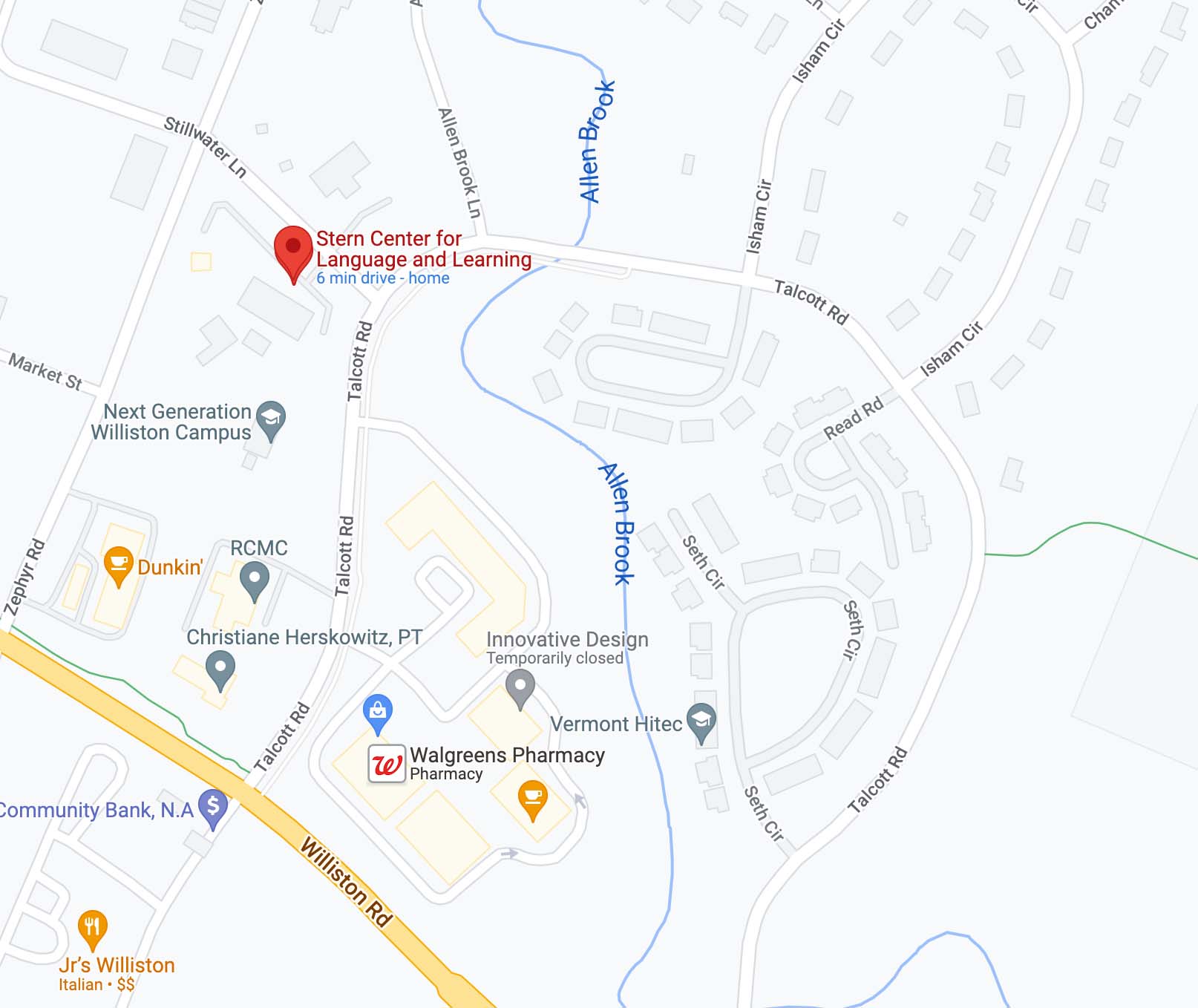
Map of Stern Stern Center for Language and Learning
Click to enlarge

Stern Center for Language and Learning

183 Talcott Rd #101
Williston, VT 05495
Phone: 802-878-2332
Fax: 802-878-0230
EIN:  222485793

  • Facebook
  • Instagram
  • LinkedIn
  • YouTube
Contact Us

Copyright © 2026 Stern Center for Language and Learning
Website by Stride Creative Group