
Skip to content
  • Skip to primary navigation
  • Skip to main content
Stern Center for Language and Learning logo

Stern Center for Language and Learning

Life-changing learning for all

  • Client Login
  • Careers
  • Contact
  • Donate
  • For Learners and Families
        • Tutoring Services
          • Reading, Writing, and Math Tutoring
          • Learning Disability Support
          • Adult Learners
          • Summer Learning
        • Social Emotional Learning
          • Speech Therapy
          • Social Thinking
          • Autism Services
          • Social Learning Summer Programs
        • Evaluations
        • Reading Readiness Check-Up
        • Student Stories
        • Financial Assistance
        • Academic Calendar
        • News & Resources
  • For Teachers
        • Courses, Coaching, & Workshops
          • Structured Literacy Coaching for Teachers
          • Orton-Gillingham Training
          • Wilson Language Training®
          • Social-Emotional Learning Courses
          • Assessment and Evaluation Courses
          • MindPlay Comprehensive Reading Course
        • Hoehl Institute for Professional Learning
          • Reducing Costs for Teachers
          • Teacher Impact Stories
          • Resources & Newsletter
  • For Schools
        • Programs and Support for Schools and Districts
          • Structured Literacy Training and Coaching
          • Orton-Gillingham for Schools
          • Wilson® Reading Programs
          • Social-Emotional Learning for Schools
          • Reducing Costs for Professional Development
          • School Impact Stories
  • About Us
        • About
          • Our Team
          • Board of Directors
          • News & Annual Reports
          • Careers
          • Contact Us
        • Ways to Give

What is the Science of Reading?

April 6, 2023

Young red headed girl reading

The science of reading draws on decades of research in neuroscience, cognitive psychology, education, and linguistics that seeks to understand how children learn to read.

Humans Aren’t Hardwired to Read

Reading is not like talking. Talking comes naturally to humans. Most children learn how to speak without any special instruction. In the same way that fish swim and birds fly, humans talk and understand speech.

Though it may look easy for some, reading doesn’t come naturally to anyone. It’s a relatively recent human invention. Learning to read and write requires us to adapt and repurpose our brains to recognize print (another thing we invented not too long ago!). As we learn how to read, we create new neural pathways in our brains and build links among previously disconnected areas, like where our brain processes language and where it recognizes images. When readers see the word ‘cat,’ their mouths can say the sounds “/kat/,” and the word holds meaning for them. Before technology allowed us to peer inside the brain and see what was really going on, most people believed reading was visual in nature. It seemed logical. We use our eyes to scan pages of print. 

Reading is a Language-Based Activity

We’ve come a long way from simply observing people read, and today we know so much more about how the brain processes print. Now we know that reading is a language-based activity that includes understanding speech sounds, linking those sounds to letter symbols, and recognizing words with increasing efficiency. For most students, understanding how print represents sounds, syllables, and meaningful word parts requires clear instruction provided in a systematic way, and practice over several grades.  

Introducing the Simple View of Reading

Anyone learning how to read needs to develop two fundamental skill sets: First, they need to be able to recognize words (and not simply make guesses about them). We teach students to sound out words and syllables (decoding) so they can eventually recognize them automatically (I see the word and read it instantly). Second, they also need to understand language and the meaning of words. This skill is called language comprehension. 

Students need both strong language comprehension and instant word recognition skills to be able to read. Experts call this the Simple View of Reading.  

To build solid decoding skills, students should be taught—in deliberate, systematic, and explicit ways—about sound or phonemic awareness, syllable types, spelling patterns, prefixes, suffixes, Latin roots, as well as Greek combining forms. 

Creating Word-Rich Environments

To understand language, children need to develop their vocabularies and general knowledge. They need to hear lots of words and have engaging conversations. Scientists have found that language development begins the day a baby is born. Reading aloud to your child from a book or any text will develop their vocabulary, open their minds to new words, thoughts, and ideas, and inspire a lifelong love of language.  

Filed Under: For Schools, For Teachers, Science of Reading

For Learners
  • Tutoring Services
  • Evaluations
  • Social Learning & Speech Therapy
For Teachers
  • Courses & Workshops
  • Structured Literacy Coaching & Teacher
  • Orton-Gillingham Training
  • Wilson Language Training®
  • Newsletter
For Schools
  • Structured Literacy Coaching & Teachers
  • Orton-Gillingham for Schools
  • School Support
About Us
  • Mission & Values
  • News & Resources
  • Giving
  • Careers
  • Contact Us
  • Media Center
  • Privacy Policy
Connect with Us
  • Facebook
  • Instagram
  • LinkedIn
  • YouTube
  • PL Newsletter
Hearts Icon

This website is made possible thanks to
the generous support of Deborah Schapiro & Louis Polish and Margie L. & Peter Stern

Stern Center

Because all great minds don’t think alike.

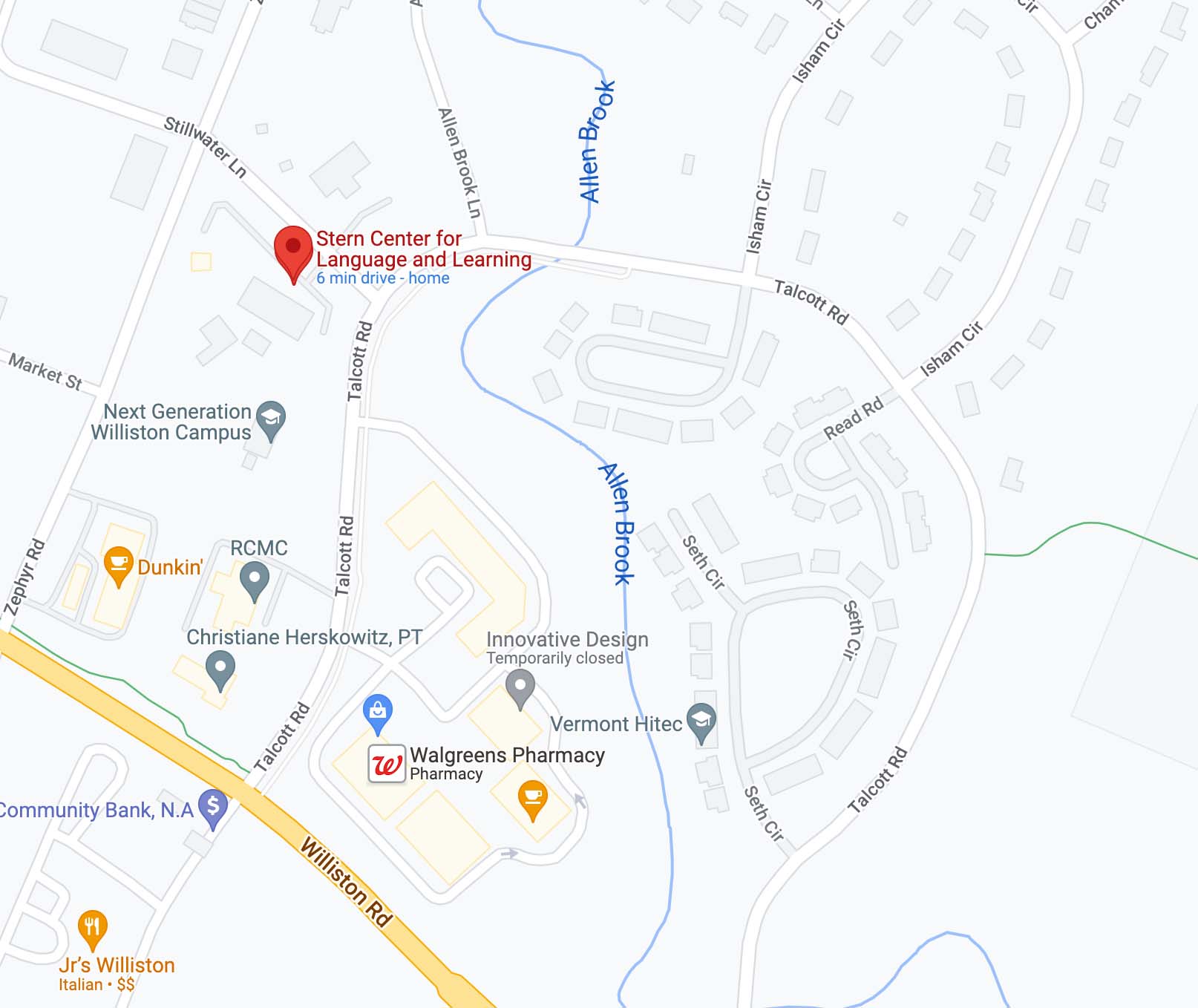
Map of Stern Stern Center for Language and Learning
Click to enlarge

Stern Center for Language and Learning

183 Talcott Rd #101
Williston, VT 05495
Phone: 802-878-2332
Fax: 802-878-0230
EIN:  222485793

  • Facebook
  • Instagram
  • LinkedIn
  • YouTube
Contact Us

Copyright © 2026 Stern Center for Language and Learning
Website by Stride Creative Group