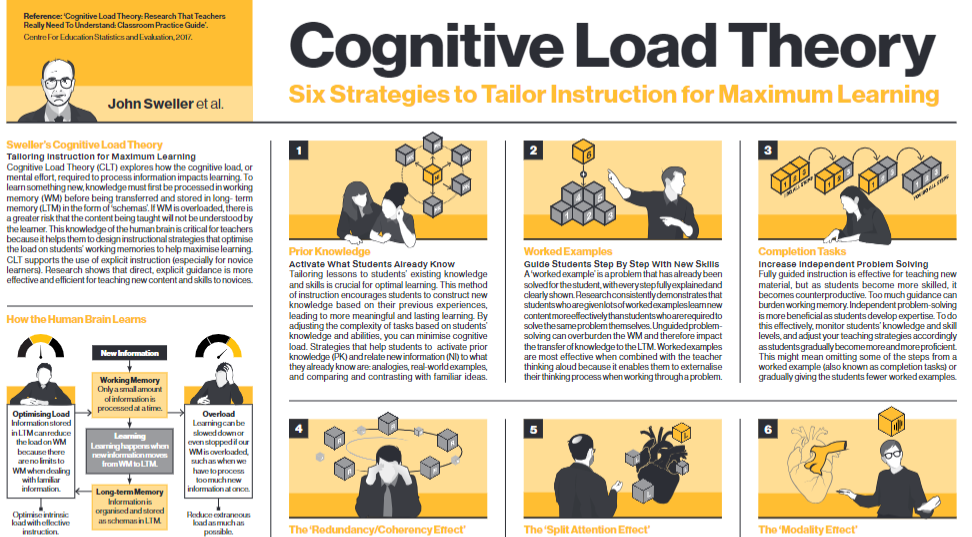
Reference: ‘Cognitive Load Theory: Research That Teachers Really Need to Understand: Classroom Practice Guide’. Centre For Education Statistics and Evaluation, 2017
By Leigh Buettler, M.S.Ed., Director of Professional Learning
After years away from knitting, I recently picked up my needles again. A college friend first showed me the ropes, but my attention waned, and I never advanced my skills beyond the basics. This winter, a local teacher reignited my love for knitting with a beginner’s scarf class. Basic skills came back quickly, and I finished two scarves with ease.
Emboldened, I signed up for a sock class. During the first session, we learned a new technique to cast on, or begin, and began knitting the cuff for one sock. It was a multi-step process, and my hand struggled to get the motions down. With each stitch, I had to consciously think, ask for repeated directions, and check that I was doing it correctly. Once that initial step was complete, we were supposed to work on the cuff. As we neared the end of the session, I realized I had been doing something wrong. I didn’t have nice, neat ribbing. Instead, I had a lumpy mess.
I called the teacher over and she showed me what was wrong. She even drew a little diagram to show me the stitches I had made versus the pattern I was supposed to make. As she talked, my mind buzzed. I could hear her words, but I wasn’t hearing them. I was so concentrated on my mistakes, the initial instruction for the cast-on, and the other modeling she had done that I couldn’t absorb any new information. I thanked her and the class ended.
I stayed up late that night frogging, or undoing, my sock and starting over. Twice. I realized what I was doing wrong and corrected my mistakes. With my teacher’s continued guidance, I was able to finish both socks in just a couple of weeks. Being able to watch her model, get corrective feedback in real time, and collaborate with a small group of other participants made all the difference. I was able to successfully grow my skills and produce something I would never have been able to on my own.
This experience mirrored what I see in students – hitting a wall can be paralyzing. It’s a reminder that as adults, we don’t always experience the challenges beginners face. What I experienced during that first sock class was cognitive overload, a state where excessive information strains working memory.
One of the most critical considerations we can take as educators is how to work with our students’ brains instead of against them. Cognitive Load Theory, or CLT, is based on the work of educational psychologist John Sweller and his colleagues in the 1980s and explores mental effort’s impact on learning. Learners struggle when information overload clogs their working memory. Teachers can optimize learning by designing lessons that minimize working memory load and enhance transfer to long-term memory.
Jamie Clark does an excellent job distilling CLT on his infographic Six Strategies to Tailor Instruction for Maximum Learning. By being mindful of students’ mental workload, we can create a learning environment that fosters growth and avoids overwhelm.
Happy learning,
Leigh Buettler, Director of Professional Learning